About the Bank - Who We Are
Published Date:
Published By:
Page Content
International Economic Cooperation: World Bank
Established in 1944, the WB aims to reduce the share of the global population that lives in extreme poverty to 3 percent by 2030 and to promote shared prosperity by increasing the incomes of the poorest 40 percent of the people in every country. This is the main collective aspiration of its 189 member countries
The WB is one of the largest sources of development funding for emerging market and developing countries. It is composed of five institutions:
(1) International Bank for Reconstruction and Development (IBRD); (2) International Development Association (IDA); (3) International Finance Corporation (IFC); (4) Multilateral Investment Guarantee Agency (MIGA); and (5) International Centre for Settlement of Investment Disputes (ICSID). The IBRD and IDA provide financing, policy advice and technical assistance to emerging markets and low-income countries, respectively; while the IFC, MIGA and ICSID focus on strengthening the private sector in member countries.
The WB is governed by the Boards of Governors, which consist of one Governor and one Alternate Governor appointed by each member country1. The Governors are usually represented by the country's Finance Minister or Central Bank Governor, and typically serve for a period of five years and may be reappointed. The powers of the Board of Governors are delegated to the Board of Directors, which consists of 25 Executive Directors. The Executive Directors represent a country or a group of countries that are appointed or elected to the position. The WB is currently headed by a President, Mr. David Malpass, from the United States who was appointed on 9 April 2019.
-----------
1If a country is a member of the IBRD and is also a member of the IFC or the IDA, then the appointed Governor and Alternate Governor serve ex-officio as the Governor and Alternate on the IFC and IDA Boards of Governors. They also serve as representatives of the country to the Administrative Council of the ICSID. The MIGA Governors and Alternates are appointed separately (Source: WB website).
The Philippines has been a member of the WB since 27 December 1945. In accordance with the designation signed by the President of the Republic of the Philippines,
Finance Secretary Carlos G. Dominguez serves as the Philippine Governor to the WB while
BSP Governor Benjamin E. Diokno serves as the Alternate Governor. The Boards of Governors of the WB and the IMF usually meet twice a year during the Spring Meetings in April and the Annual Meetings in October.
-
Representation. The Philippines is represented in the WB through the Office of the Executive Director for Brazil, Colombia, Dominican Republic, Ecuador, Haiti, Panama, Philippines, Suriname, and Trinidad & Tobago (EDS15). The current Executive Director of EDS15 is
Mr. Abraham Weintraub from Brazil and the Constituency maintains a constructive dialogue with the country authorities, management, and staff.
- The Philippines is a member of all the 5 institutions under the WB Group. The date of membership as well as the voting power, which is largely based on shareholdings (and subsequent periodic capital increases), is provided in the table below.
|
|
Date of Philippine Membership |
Voting Power |
|
IBRD | 27 December 1945 | 10,658 (0.42 percent) |
|
IDA | 28 October 1960 | 146,094 (0.51 percent) |
|
IFC | 12 August 1957 | 110,448 (0.53 percent) |
|
MIGA | 8 February 1994 | 1,077 (0.50 percent) |
|
ICSID | 17 December 1978 | NA |
-
Loans. The WB provides a wide array of financial products to the Philippines, in the areas of infrastructure, governance, social protection, agriculture, water resources, and disaster risk management.
-
Country Partnership Framework (CPF) for the Philippines for 2019-2023. The CPF prioritizes investments in human capital (health, education, and nutrition), competitiveness and job creation, peacebuilding, climate and disaster resilience, governance, and digital transformation. An overview of the WB's Philippines Country Partnership framework is presented in the next table.
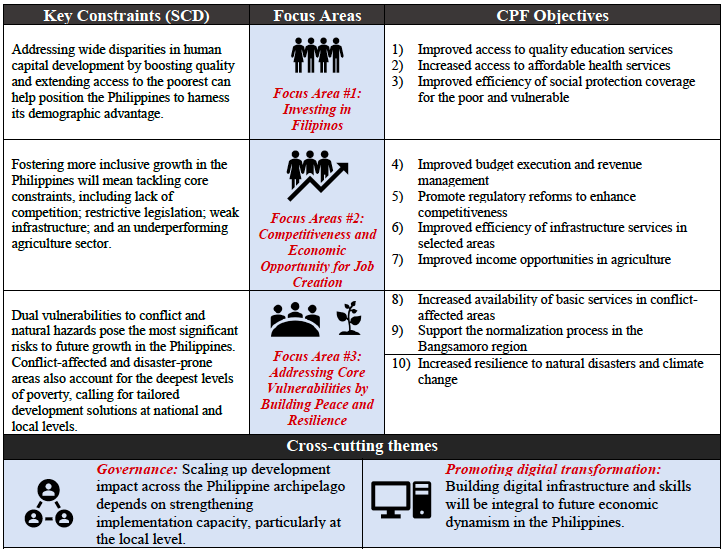
Source: IBRD IFC MIGA Country Partnership Framework for the Republic of the Philippines for the Period July 2019 to December 2023.
Created:9/30/2020 10:49 AM by:
Rhodawynn Concepcion Obillo-Segun
Modified:3/3/2021 4:41 PM by:
Rhodawynn Concepcion Obillo-Segun

